
 admin
admin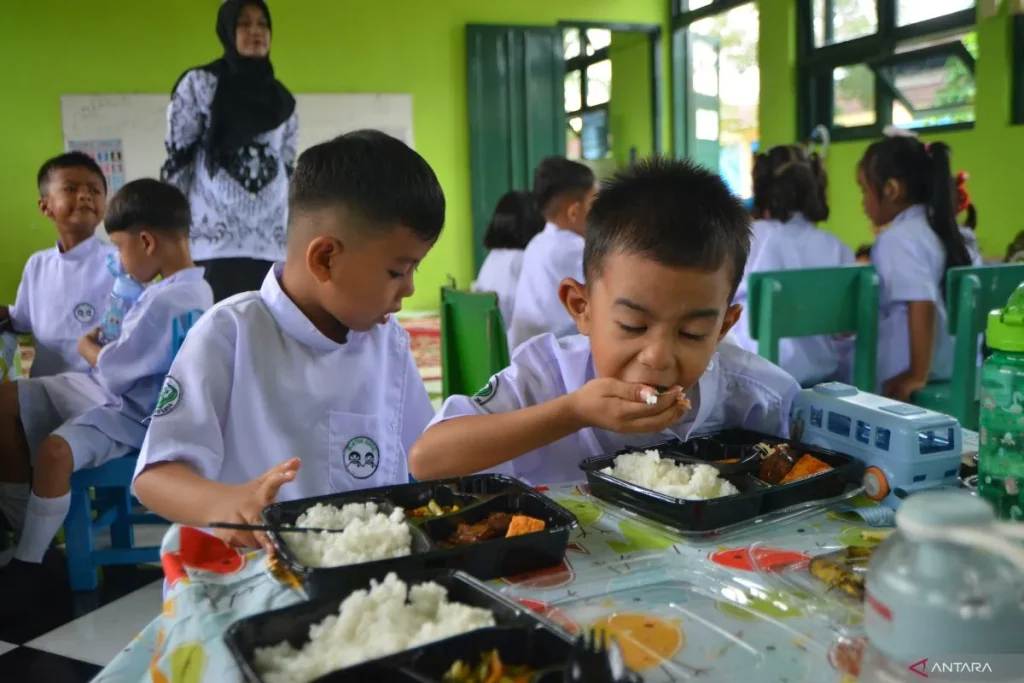
By: Erlangga Pratama
KN-Jakarta, President Prabowo Subianto confirmed that the free nutritious meal program (MBG) will continue amidst budget cuts resulting from the global crisis. He stated that savings can be focused on other sectors. Prabowo made this statement during a discussion session with journalists and observers broadcast on Prabowo Subianto’s YouTube channel on Sunday (March 22, 2026). The President emphasized that he would maintain the MBG program to ensure the public’s nutritional needs, as he encountered many stunted children during the campaign.
“I will defend it as best I can rather than have money embezzled. It’s better for my people to be able to eat. You don’t see stunted children. I see them; I campaigned several times in villages. I see children asking, ‘How old are you?’ 11 years old. They have the body of a 4-year-old,” Prabowo said, optimistic that the state budget will be sufficient to continue the MBG program.
He believes there are many other sectors that can be saved without sacrificing this strategic program. The MBG program has been implemented in more than 100 countries. Indonesia is the 77th country to launch the program.
Prabowo revealed that the MBG program has received attention from international institutions, including the Rockefeller Institute and the UN’s World Food Program (WFP). Based on their studies, every dollar invested in the program can yield multiple benefits, both in the short and long term.
“I was visited by the Rockefeller Institute from the United States to check on our SPPG. They came to me and said, ‘This is the best investment, Mr. President, you have made the best.’ Do you know why? Because every dollar spent on the MBG has a return of between 7 and 35, in the long run 35, in the short run 7 dollars, and this is from the Rockefeller Institute. This is also a UN World Food Program,” he said.
The President acknowledged that there are still various shortcomings in implementation on the ground. The government has taken action against several violations, including closing more than a thousand service points that do not meet standards. According to him, the MBG program is very meaningful for groups that have not enjoyed equitable economic growth, especially in areas outside Java, which are considered to still be in dire need of such support. “The top 10-20% may enjoy it. But most of us have had a very difficult life. Can you imagine how happy they are? If it were the children of rich people in Menteng, they wouldn’t need this,” he added.
Clear Message Regarding MBG
Through the MBG program, we can receive a clear message from the President that he has the goodwill to realize this populist program during Prabowo Subianto’s presidency. We must see the MBG program as a “revolutionary program,” particularly regarding how to accelerate equitable prosperity and an effort to implement the constitutional mandate to increase the global competitiveness of Indonesian children, starting with steps to improve and enhance the quality of health and nutritional adequacy of Indonesian children. Of course, as a “revolutionary” program, it is not surprising that this noble program has received criticism and resistance, but it seems that it does not need enough attention because the material of criticism against MBG from interest groups who feel “backfire” because of this MBG is not proportional.
Unreasonable criticisms, such as the prohibition of many SPPGs from operating by the National Nutrition Agency (BGN) before obtaining a Hygiene Sanitation Certificate (SLHS), demonstrate the government’s determination to maintain the quality of the MBG program by addressing all fundamental aspects.
Meanwhile, the government has acknowledged cases of food poisoning stemming from the SPPG program. However, it is important to note that these cases are few and far between, deliberately hyped up by groups opposing the MBG. However, it is important to note that the President has ordered firm action against all violations and irregularities related to the MBG. “No mercy,” and the public should not doubt the head of state’s firmness in enforcing the law.
Meanwhile, in an effort to improve governance and transparency in the implementation of the MBG program, the National Nutrition Agency (BGN) is increasingly meticulous in operational readiness and target data collection. This ensures that distribution to vulnerable groups (pregnant women, breastfeeding mothers, and toddlers) demonstrates consistent evaluation and follow-up of the MBG program audit results by relevant parties.
Unreasonable criticism of the MBG has also been made by former members of Hizbut Tahrir Indonesia (HTI), particularly through their social media accounts, glorifying the Free Nutritional Meals (MBG) program as having caused various problems, such as budget waste, food quality, and alleged elite interests. This is in contrast to the concept of public welfare management in the Islamic system.
The MBG program has become the target of negative propaganda by former HTI groups, who exploit operational issues to spread ideological narratives and discredit the government. The author also believes that anti-MBG interest groups are also struggling to substantiate their accusations and criticisms, which appear to be more motivated by political agendas than truth.
An informed public will clearly support the implementation of the MBG, as demonstrated by the Papua Pegunungan SPPG, which is actively pushing for the acceleration of halal certification and conducting food safety and hygiene training for MBG kitchen managers.
The President and his government will appreciate the steps taken by community elements in supporting and providing constructive suggestions regarding the MBG, including the suggestion that the beneficiaries be expanded to include street children and retirees. This is a humanitarian suggestion worthy of the President’s attention, as it demonstrates a positive intention to support the MBG.
*Free Nutritious Meal Program: The State’s Answer to Child Nutrition Problems*
The Free Nutritious Meal Program (MBG) is a strategic policy based on the state’s concern for the nutritional status of Indonesian children. Numerous studies indicate that the percentage of Indonesian children suffering from malnutrition reaches more than 20 to 30 percent. This situation demands the government’s direct and measured intervention to safeguard the future of the nation’s generations through the Free Nutritious Meal Program (MBG). The MBG program, which began exactly one year ago on January 6, 2026, has successfully reached 55 million beneficiaries, with a 99 percent success rate.
Through the MBG program, the President emphasized that responsible leaders must work hard to eradicate hunger and poverty. Therefore, the President also called on all levels of government to remain confident in their commitment to eradicating poverty and eliminating hunger for the future of the nation.
“We will prove it. If our intentions are pure, our intentions are not to steal the people’s money, and we act for the benefit of the people, the benefit of our nation, and the safety of our nation, we need not hesitate, we need not be afraid in the slightest,” he concluded.
“We will prove it. If our intentions are pure, our intentions are not to steal the people’s money, and we act for the benefit of the people, the benefit of our nation, and the safety of our nation, we need not hesitate, we need not be afraid in the slightest,” he concluded.
Once again, the MBG program is a form of the state’s presence and response to the problematic national situation that the previous administration has not resolved. So far, no circumstances have disrupted MBG, and the government’s capability has been prepared for it. So, there is no other choice but to continue MBG and fully support this populist program for the future of our children.
*The author is an international affairs observer and an alumnus of the Faculty of Social and Political Sciences, University of Jember, and a postgraduate at the University of Indonesia
Photo: by. ANTARA



 Glembert