Glembert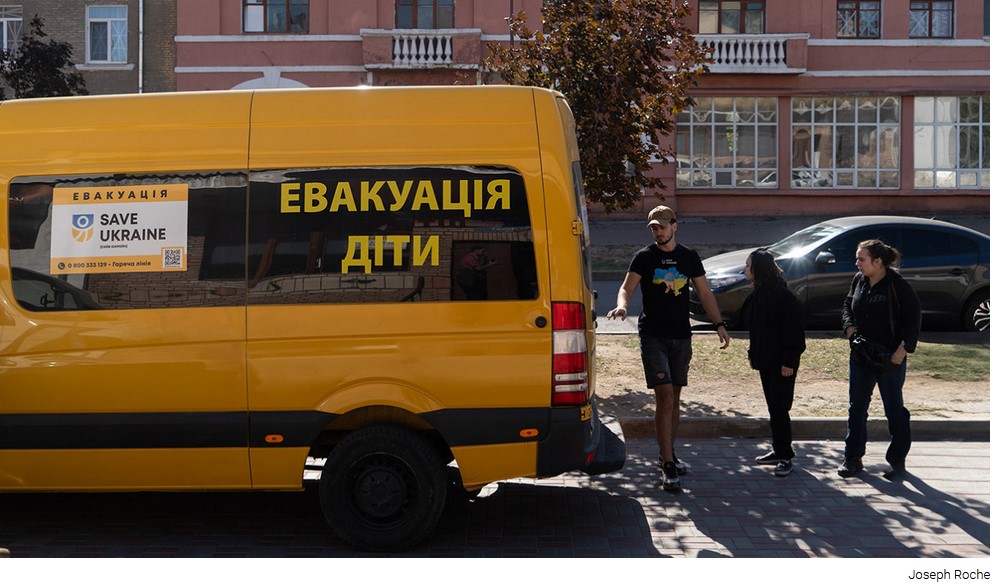
KN. Sitting on the steps of his church, now transformed into a refugee center, Evgueny, the congregation’s pastor, enjoys the last rays of sunshine before winter. In the distance, two explosions a few seconds apart make the windows of the small reception center tremble.
With a gaunt face and gentle eyes, Evgueny, in his early 40s, is one of the Protestant pastors of Kramatorsk, one of the last major cities in the Donbas still under Ukrainian control and a key logistical hub for the Ukrainian army that also serves as a safe haven for refugees from the region.
Since the beginning of summer, Russian forces, in a renewed offensive in the Donbas, have managed to push their front line to within about 10 kilometers of Pokrovsk, another logistical center for the Ukrainian army in the Donbas, while also intensifying their activities toward Chasiv Yar, located 26 kilometers from Kramatorsk.
This momentum especially accelerated after the fall of the critical defensive fortress of Vuhledar in early October.
This is the case for Iryna, a woman in her 50s who fled less than a week ago from her parents’ farm in the suburbs of Chasiv Yar.
With a frightened look, Iryna brings her thin hands to her face and flinches at every detonation coming from the front line about 20 kilometers away.
Iryna is one of those refugees who, too poor to leave, waited until the last minute to flee.
Iryna stops her story abruptly. Her eyes fill with fear, and even the autumn light struggles to shine in her pupils darkened by terror.
Iryna doesn’t know where to go. Without money and family, she will stay a few more days at the Kramatorsk center before being relocated to a center for internally displaced persons.
As for aid, she can expect to receive between 2,000 and 3,000 hryvnias (around $50) per month from the Ukrainian state, which barely covers basic needs.
Faced with this situation, Evgueny explains that their church tries to help some of the displaced people financially.
Philippe Jacob, 30, a Luxembourg-born evacuation worker who has been working in Ukraine since September 2023, is also concerned about the developments on the front.
Working primarily in villages around Pokrovsk, he sees the Russians advancing gradually every day.
In the face of denial or stubbornness from some residents, Philippe recounts how his organization is often called by family members who beg them to go and rescue relatives who stayed behind. “It’s mostly the elderly or the sick who remain. They generally have small pensions, barely 4,000 hryvnias, and no real place to seek refuge,” he says.
Despite his determination, Philippe is uncertain how much longer they’ll be able to continue working. Growing increasingly vulnerable to Russian drone attacks, he confides that their missions are becoming more dangerous.
Earlier in October, Philippe lost one of his friends on an evacuation mission.
Tigran Galustyan, an evacuation worker from the organization Rose on the Hand, was killed by a Russian FPV drone as he tried to drive Ukrainian civilians out of the town of Kurakhove.
But even the drone jammers used, according to Philippe, are becoming less effective against Russian attacks. “Tigran was driving with both jammers on, but the Russians now use low frequencies to bypass our jamming systems,” Philippe sighs.
On the doorstep of the Kramatorsk center, Oxana, in her early 50s, carries two large gingham-patterned plastic bags. Behind her, her five children carry what little remains of their former life as best they can.
Originally from Kostiantynivka, a small town between Kramatorsk and Chasiv Yar, about 10 kilometers from the front, they arrived yesterday.
But Oxana’s decision to finally flee came last year, when she narrowly escaped a bombing at Kostiantynivka’s market in September 2023.
The attack killed 15 people and injured 32. Its origins remain unclear and, according to a New York Times investigation, could have been a mistake by Ukrainian artillery. But since then, the Russians have relentlessly bombarded the small town almost daily.
A year later, after taking the time to organize and prepare their departure, Oxana finally took the plunge and decided to flee to the Ukrainian capital.
Yuliia is excited to leave and explains that many of her friends are already refugees in Kyiv. “My best friend is waiting for me there,” she says, smiling. “And I want to go back to a real school. Between Covid and the war, I can barely remember the last time I attended an in-person class. After high school, I hope to go to university in Kyiv to study art.”
But without a job and recently divorced, Oxana is unsure of what to expect. “All I can tell you is that the future is uncertain, but I hold onto God and pray. What else can we do in our situation?”

 admin
admin