Glembert
KN. The reports from South Korea’s National Intelligence Service that over 1,500 North Korean troops were sent to Russia this month to train for deployment to Ukraine, marking the first instance of a foreign army’s direct involvement in the war. On Wednesday, U.S. Secretary of Defense Lloyd Austin confirmed the claim. The development has raised alarm, with Ukrainian President Volodymyr Zelensky warning that North Korea could be preparing to send thousands more troops — potentially up to 10,000 — to support Russia’s war machine. At the same time, allegations of North Korea supplying arms to Moscow are gaining traction, with evidence including recovered North Korean missile debris in Ukraine backing South Korean intelligence claims that North Korea has shipped over 13,000 containers filled with shells, missiles, and anti-armor rockets to Russia since August 2023.
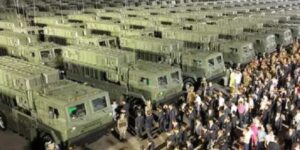
Pyongyang’s direct involvement in the Russia-Ukraine war marks a new and dangerous escalation in its growing alliance with Moscow, a relationship rooted in the Soviet Union’s role in establishing the Kim family regime. While their ties have fluctuated over the years, the two countries have drawn closer since Russia’s 2022 invasion of Ukraine. In exchange for providing war resources and helping expand Russia’s influence in East Asia, North Korea has gained economic aid, diplomatic support, and important military technology. Their alliance was further solidified in June 2024 when Russian President Vladimir Putin visited North Korea to sign a strategic partnership treaty, which includes mutual defense clauses and promotes cooperation in areas like food, energy, and weapons technology. Notably, Article 4 of the treaty stipulates that North Korea and Russia “shall immediately provide military and other assistance” to the other country if it “falls into a state of war due to armed invasion from an individual or multiple states.”
This growing relationship has raised significant concerns among experts regarding nuclear proliferation and regional stability. Moscow’s backing of Pyongyang in the UN Security Council has allowed North Korea to advance its nuclear and missile development programs with limited international repercussions. This diplomatic shield, combined with the possibility that Russia is supplying critical military technology in exchange for North Korean troops, has heightened security fears in the region. The situation is especially troubling given the recent escalation of tensions on the Korean Peninsula, including North Korean leader Kim Jong Un’s aggressive steps to permanently sever ties with South Korea — such as the destruction of part of a key road linking the two countries — and his alarming threats of preemptive nuclear strikes.
As Russia’s war in Ukraine drags on with no end in sight, Moscow has continued to deepen its ties with other nations unaligned with the West, including Iran. Russia and Iran’s relationship gained momentum in 2015, when President Putin sent forces to prop up the beleaguered regime of Syria’s dictator Bashar al-Assad against a range of forces attempting to topple him, including Islamic State, Jabhat al-Nusra, and various other entities. Iran also sought to support Assad by sending advisers from the Islamic Revolutionary Guard Corps (IRGC) and facilitating the deployment of fighters from Lebanese Hezbollah, who fought alongside Russian mercenaries from the Wagner Group. More recently, Iran provided Russia with drones that the Kremlin requested for its war in Ukraine.
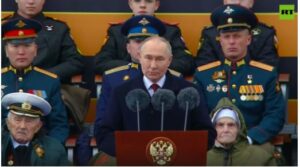
The states in this “Iron Triangle” –– Russia, North Korea, and Iran –– have increasingly aligned their interests on the global stage, viewing their partnership as key to challenging the Western-dominated world order. Their cooperation has played a critical role in prolonging the Russia-Ukraine conflict, with North Korean and Iranian assistance boosting Russia’s ability to sustain its assault. The ongoing wars in Syria and the broader Middle East, along with sustained Western sanctions, have also cemented this growing alignment. Iranian leaders view the conflict in Ukraine as an opportunity to increase Moscow’s reliance on Tehran, while also seeking advanced Russian military hardware like the Su-35 fighter jets and the S-400 missile defense system. Reports indicate that by providing short-range ballistic missiles to Russia, Tehran had hoped to strengthen its negotiating position and gain more influence with Moscow.
While the conflict in Ukraine has undeniably strengthened ties between the Iron Triangle, it also provides a roadblock to this growing relationship. Russia has little desire to become fully entangled in another conflict while it remains heavily engaged in Ukraine. North Korea is not a stable ally in this regard. While it is not actively engaged in conflict at the moment, its relationship with South Korea is tumultuous at best, and could escalate easily. For Iran, maintaining Russia’s favor is even more complex as tensions with Israel continue to rise.
Moscow experienced some of the consequences of its relationship with Tehran in early October, when a suspected Israeli airstrike near Russia’s Khmeimim airbase reportedly targeted a site believed to be storing weapons for Iran and its proxies in the so-called ‘Axis of Resistance.’ Up to 30 missiles were fired, with secondary explosions suggesting munitions were hit. Russia frequently backs Iran in its disputes with Israel, as demonstrated by Moscow’s support for Iran in April when Tehran launched a missile barrage in response to Israeli airstrikes. In Syria, the two nations worked together to challenge U.S. influence, with Russian jets engaging in provocative maneuvers near a U.S. aircraft. However, as Tehran once again seeks increased military support from Moscow, Russia may no longer be as willing to meet Iran’s growing expectations. Economically, Iran plays a minor role in Russia’s trade, contributing only around one percent to its total turnover. Russia is also increasingly producing Iranian military equipment, such as drones, domestically, reducing its dependence on Iranian supplies.
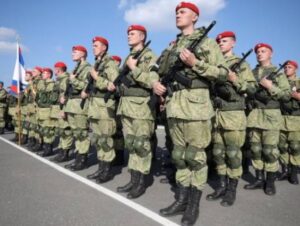
However, strikes on Iranian infrastructure could jeopardize important collaborations between Russia and Iran, including joint gas projects, the International North–South Transport Corridor, and broader economic ties. Moreover, if Israel and the U.S. were to weaken or eliminate one of Russia’s most reliable allies, it would severely undermine Moscow’s geopolitical ambitions. Therefore, it remains in Russia’s interest to continue supporting Iran, even if this support becomes more cautious and falls short of Tehran’s expectations. Many had hoped that escalating tensions between Iran and Israel might disrupt the “Iron Triangle” alliance, but this is unlikely.
The upcoming BRICS summit in Kazan, Russia later this month, further underscores the shifting power dynamics and the potential formation of an anti-Western axis. As Russia deepens its ties with North Korea and Iran, it simultaneously seeks to strengthen its influence through alliances with emerging economies like Brazil, India, China, and South Africa. The summit aims to challenge the Western-dominated world order by reducing reliance on Western financial systems. It also provides a platform for Putin to assert Russia’s influence and counter Western narratives of isolation amid ongoing sanctions due to the Ukraine war.
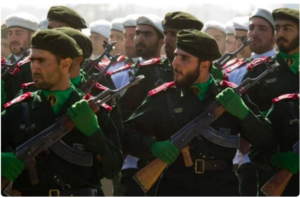
However, despite these developments, Russia’s efforts to significantly reshape the global order have faced challenges. Cooperation among the Iron Triangle nations, as well as the BRICS nations, remains largely bilateral and opportunistic. These countries often collaborate on specific issues rather than aligning under a unified ideology or common goal, demonstrating how nations are leveraging their options – rather than fully aligning with one “superpower” over another – in a multipolar world. They are further divided by internal differences and weak economic ties. Additionally, though China plays a crucial role in this landscape, it is not officially part of the Iron Triangle, as its strategic interests often diverge from those of Russia, North Korea, and Iran. While China shares some geopolitical ambitions with these countries, it must balance its economic ties with the West to avoid jeopardizing important trade relations. This divergence complicates the formation of a unified front and, without China’s support, undermines the Iron Triangle’s ability to effectively challenge the established global order.


 admin
admin