Glembert
KN. Speaking at an economic discussion dubbed “Strengthening Indonesia’s Economic Resilience in the Midst of Trade Tariff Waves” in Jakarta, Prabowo expressed concern over the implications of the U.S. decision.
“Currently, we are witnessing how an economic superpower is shaking the world by imposing high tariffs on many countries — a move that has triggered global uncertainty. Many nations are in a state of anxiety,” he said. Despite these concerns, Prabowo emphasized that his administration will remain calm in responding to U.S. policy shift and reaffirmed Indonesia’s commitment to economic self-reliance.
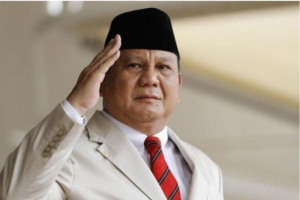
Prabowo said how the U.S.’ latest tariff blitz had shown the importance for a country to stand on its own two feet and not rely on other nations. Speaking in front of Indonesian senior economists and businessmen, Prabowo made a highly anticipated comment on Trump’s tariff salvo, despite shielding away from directly referring to Trump or the U.S. by name. “For years, our founding fathers and I have said that we must stand on our own two feet in our economic development,” Prabowo added.
Finance Minister Sri Mulyani criticized US President Donald Trump for not using economics in setting tariffs, including Indonesia’s 32 percent tariff.
“The reciprocal tariff submitted by America to 60 countries illustrates the method of calculating the tariff, which I think all economists who have studied economics cannot understand,” she said at an Economic Discussion at Menara Mandiri Sudirman, Central Jakarta. “So, this is also no longer valid economics, what is important is the tariff first,” criticized Mulyani.
Luhut said “The government will prepare policies to support sectors impacted by the US tariffs, particularly labor-intensive industries.” … “DEN sees that the reciprocal tariff from America is not entirely negative. Repositioning global trade can be an opportunity for Indonesia to attract investment from abroad, making Indonesia its production base.”
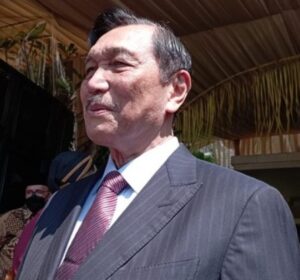
Indonesia announced a raft of concessions on U.S. imports, including reducing taxes on electronic goods and steel, ahead of trade negotiations with Washington over President Donald Trump’s sweeping tariffs.
Southeast Asia’s biggest economy will send a high-level delegation to the United States next week in hopes of securing a deal to ease the impact of a 32 percent tariff due to take effect on Wednesday. Indonesia plans to buy U.S. liquefied petroleum gas, liquefied natural gas and soybeans as part of the negotiation efforts, said chief economic minister Airlangga Hartarto, who will lead the delegation traveling to Washington on April 17.
Minister Airlangga Hartarto emphasized that Indonesia’s copper, gold, and furniture exports to the United States are not subject to a 32 percent reciprocal tariff. According to Airlangga, this is because U.S. companies also produce copper and gold in Indonesia. Meanwhile, furniture manufacturers there must find alternative raw materials outside of Canada.
President Donald Trump has once again surprised the world by announcing a 90-day delay on import tariffs for 75 countries, while simultaneously increasing tariffs on Chinese imports to 125%. During a press conference, Trump stated that the tariff suspension was in response to widespread concerns and reactions to his earlier tariff implementations.
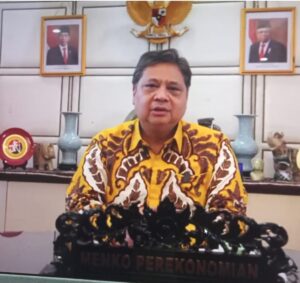
He remarked, “I saw people starting to get rowdy and fearful, not like champions.” Treasury Secretary Scott Bessent clarified that the decision to pause tariffs was influenced by numerous countries expressing a desire to negotiate trade terms. He emphasized that the suspension was not a reaction to market fluctuations but a response to diplomatic outreach. However, the tariff suspension does not extend to China. President Trump announced an immediate increase in tariffs on Chinese imports to 125%, citing China’s reluctance to engage in negotiations and its retaliatory measures against the U.S.
Prabowo during an economic forum in Jakarta instructed the Red and White Cabinet to establish a special task force to handle layoffs as part of anticipatory measures against the impact of reciprocal tariffs imposed by the United States.
Economic Affairs Coordinating Minister Airlangga Hartarto met with U.S. Ambassador to Indonesia Kamala S. Lakhdhir to discuss the revitalization of trade relations between Indonesia and the United States, following the imposition of reciprocal tariffs by the latter on several countries. The meeting marked the beginning of bilateral negotiations focused on addressing the U.S. tariff policy and exploring ways to enhance trade and investment cooperation.
Ambassador Kamala expressed her support for Indonesia’s efforts, saying that the U.S. Embassy in Jakarta is committed to facilitating communication and negotiations amid similar initiatives being pursued by other countries affected by former President Trump’s tariff policies.
National Economic Council (DEN) Chair Luhut Binsar Pandjaitan said that the Indonesian delegation, led by Economic Affairs Coordinating Minister Airlangga Hartarto, along with the Foreign Affairs Ministry, Trade Ministry, and DEN, will hold reciprocal tariff negotiations with U.S. authorities on April 17, or next week. According to Luhut, DEN has already provided negotiation strategy recommendations to the delegation. He also mentioned that Indonesia has prepared a proposal to negotiate reciprocal tariffs with the United States.
U.S. President Donald Trump announced a postponement of new import tariffs on Indonesia and several other countries for the next 90 days, but continued high reciprocal tariffs for China of up to 125 percent. Trump stated on his Truth Social account that this postponement only applies to countries that do not retaliate against the U.S. tariff policies.
Trade Deputy Minister Dyah Roro Esti said Indonesia would keep tabs on the developments following the postponement. “We will continue to uphold negotiations. … This [delay] is a positive signal. Indonesia is among the ASEAN countries that do not retaliate,” Dyah Roro told reporters.
Finance Minister Sri Mulyani Indrawati said U.S. tariffs could push Indonesia’s gross domestic product (GDP) growth down “by between 0.3 and 0.5 [percentage points],” Reuters reported, but she noted the estimate was based on calculations made prior to Trump’s suspension of the steep tariffs. Mulyani said the 90-day delay in implemention allows for negotiation and the development of mutually beneficial solutions.
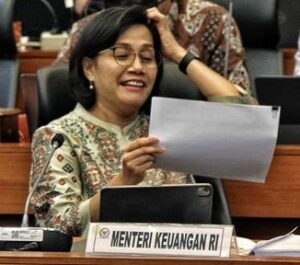
Indonesia should hold off on entering negotiations with the United States over the recently announced 32 percent “reciprocal” tariffs, an international trade expert said warning that the United States itself may not be fully prepared for talks. Former Trade Ministry Director General Iman Pambagyo said the current circumstances suggest the U.S. administration is still assessing the implications of its own policy.
During a public discussion hosted by CSIS Indonesia dubbed “Regional Response to Trump 2.0” in Jakarta, AmCham Indonesia Managing Director Donna Priadi said that U.S. companies believe regulatory changes are urgently needed not only to respond to Trump’s tariff policies but also to improve Indonesia’s investment climate and ease of doing business.
Managing Member of Great Hill Capital LLC, Thomas J. Hayes, in an interview with CNBC Indonesia, said that in his view, tariffs as they relate to Indonesia are not as bad as the public thinks. According to him, the Indonesian government was smart that they chose not to retaliate, and they’re going to wind up with a great deal with the United States as opposed to China.
Institute for Development of Economics and Finance (Indef) senior economist Didik J. Rachbini emphasized the need for Indonesia to establish a third bloc as part of a broader political consolidation in response to the U.S. tariffs, saying Indonesia should align with ASEAN, East Asian nations such as Japan, South Korea, and Taiwan, as well as India, and also partner with Latin American countries like Brazil and Mexico.


 admin
admin